


AI Is Not Replacing Designers — It’s Revealing Who We Are
Artificial intelligence is transforming design—but not in the way most people think. This article explores how automation is not replacing designers, but demanding stronger judgment, strategy, and systems thinking. A perspective grounded in real experience on the future of design, design systems, and human value in the age of AI.
ARTIFICIAL INTELLIGENCE
4/2/20263 min read


Have you heard the news about how China has eliminated some visual-related careers because artificial intelligence is pushing us to evolve?
I don’t take this from an emotional place.
I take it from somewhere I know very well: resilience.
I’m Latina. And my grandmother always told me:
“In this life, everything has a solution—except death.”
For years, I could say I was a great graphic designer.
Not because of a title, but because of real experience—working with teams, with clients, being a reference for some and a teammate for others.
The people who have worked with me know this:
My actions speak louder than these words.
Now we are facing something much bigger.
This is not comparable to anything we’ve experienced before.
And I know this because every day I train my mind:
I read, I listen, I learn, and I observe—carefully.
I follow voices like Karen Hao, Elon Musk, Sam Altman, Dario Amodei, and many others who are both building and questioning this new world.
I also pay close attention to the movements between global powers like China and United States.
Because this is not just about technology.
It’s a shift in humanity.
I could approach this from fear.
After all, I am an artist.
My profession comes from the heart.
But I’ve come to understand something:
This is not about defending who we were.
It’s about understanding who we need to become with judgment, with conviction, and with a clear sense of who we are, both in our field and as human beings.
Today, I see artificial intelligence for what it truly is:
A powerful tool—one that is even beginning to surpass human capabilities.
But I also see it as a filter.
Because when design becomes automated—when processes are automated—
quality and coherence do not happen by default.
They require direction.
And that’s where I come in.
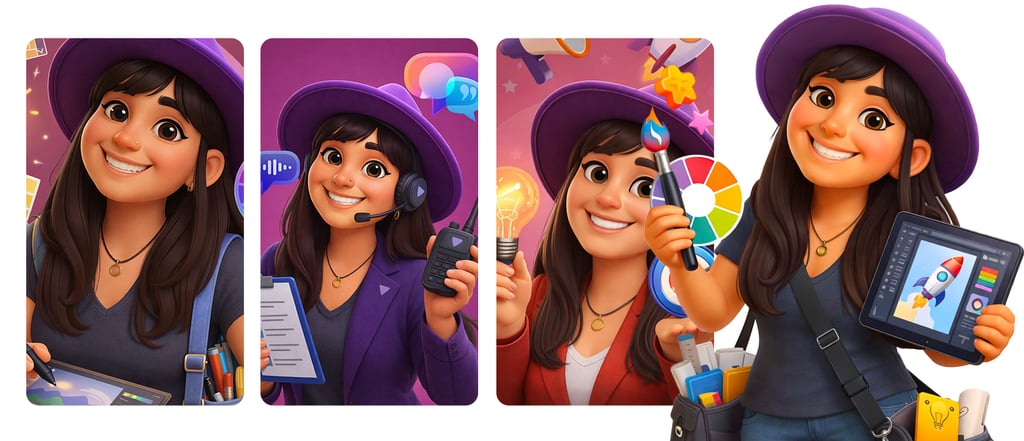
What am I doing?
I’ve spent the last few years understanding how these systems work—
testing tools, building workflows, and connecting technologies.
I’ve worked with models, agents, automations, and integrations with tools like Figma and various AI platforms.
I’ve tried to build complete orchestration systems.
And yes—they work.
But I’ve also come to understand their limits.
Because when you’ve lived design in the real world:
when you’ve spent hours watching how a plotter interprets color, and you understand that design doesn’t end on the screen,
when you’ve moved through both small and large agencies—observing processes, learning from every mistake and every decision,
when you’ve been part of strategic decisions alongside senior stakeholders within organizations,
when you’ve worked for years with clients—small and large—understanding their real contexts,
and when you were told that being multitasking or wanting to learn too much was a mistake…
Today, I understand that learning everything was never the problem.
It was my greatest advantage.
And I understand something else that AI still cannot replace:
Judgment.
Artificial intelligence does not think for you.
It amplifies who you are.
And in my case, it has pushed me to become better:
more clear,
more strategic,
more aware,
more critical,
more adaptable,
more human and empathetic.
I will never compromise the quality of my work.
And today, I can say this with complete honesty:
Thank you, artificial intelligence.
Because you pushed me to go beyond what I thought I was capable of.
To close, there’s something I’m certain about:
The only way to evolve in this moment is not just by learning tools.
It’s about developing a deeper connection with life,
with judgment,
and with what truly creates value.
This is not the end of design.
It’s the end of design without direction.